
By: Valerie Afriat, Licensed Optician & Founder, Niche Eyewear Boutique
Here’s the truth I share with clients every day inside the boutique: if you have a stronger prescription, you’ve probably been told you “need” the thinnest lens available.
Sometimes that’s true. Often, it’s not.
If you’ve ever picked up your glasses and felt surprised by the weight or caught your reflection and noticed thickness at the edges; you’re not imagining it. Stronger prescriptions require more lens power, and without the right materials, that translates into bulk. This high index lens guide will walk you through exactly what the options are, which index genuinely suits your prescription, and how to make a decision that feels informed, elevated, and worth your investment.
I wear a -10 diopter prescription myself. I say that not to establish credentials, but because it means I understand this conversation from the inside. I know what it feels like to pick up a pair of glasses and feel the weight before you even put them on. I know what edge thickness looks like in a mirror, and I know what it means when a lens that should be clear still leaves you with distortion at the edges by the end of the day. That personal experience is behind every recommendation I make at Niche.
“True luxury is never about excess. It’s about precision. And that’s how I approach every lens conversation at Niche.”
Understanding High Index Lenses
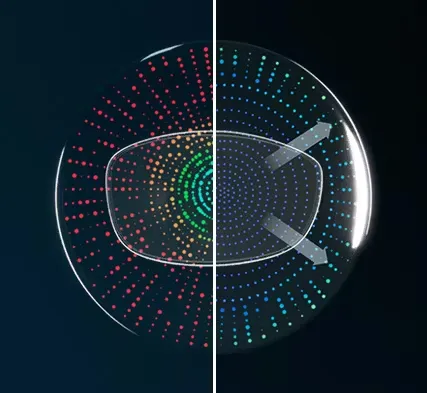
High index lenses bend light more efficiently than standard lenses. This allows us to achieve your prescription with less material which means thinner, lighter, and far more refined results.
What that means for you in practice: a slimmer profile from both the front and the side; less weight on your face across a full day’s wear; and a more polished, balanced look in virtually any frame.
For clients with moderate to strong prescriptions, this isn’t just an upgrade. It’s essential to how the glasses feel and look. The question is simply which index and that’s where most people need proper guidance.
Choosing the Right Index for Your Prescription, Not Just the Highest One
One of the most common misconceptions I see is that higher index automatically means better. It doesn’t. It means thinner but only to a point that is relevant to your prescription and your frame. Choosing unnecessarily is spending without return.
- 1.50 Index: Minimal prescriptions only. Rarely recommend in boutique.
- 1.60 Index: Mild to moderate (±2.00–±4.00). Approximately 20% thinner than standard. A beautiful balance at this range.
- 1.67 Index: Moderate to strong (±4.00–±8.00). Approximately 30% thinner. Where most clients land. The sweet spot.
- 1.74 Index: Strong to very strong (±6.00+). Approximately 40% thinner. Exceptional when truly needed.
At Niche, we don’t recommend an index because it’s the premium option. We recommend it because it’s the right one for your prescription, your frame, and the result you’re trying to achieve.

1.67 vs. 1.74 Lenses: What I Actually Recommend in Practice
This is the question I’m asked most often. And it deserves a direct answer.
1.67 lenses: the sweet spot for most clients
If your prescription is under ±6.00, I usually recommend 1.67 lenses. The difference in thickness between 1.67 and 1.74 at this range can be subtle and sometimes almost imperceptible once the lenses are in the frame. But the difference in cost is not subtle. For most clients in the ±4.00 to ±6.00 range, 1.67 delivers a genuinely refined result without paying for a marginal improvement.
1.74 lenses: when they are genuinely worth it
If your prescription is ±6.00 or above, or you’ve chosen a larger frame, 1.74 becomes a more meaningful upgrade. At higher prescriptions, the extra thinness is visible and worth the investment. For prescriptions above ±8.00, 1.74 lenses are often the right choice, and the result can genuinely surprise clients who have lived with thick lenses for years.
“The goal isn’t to sell you the thinnest lens. It’s to help you understand which lens is actually thin enough — for you.”
What Really Determines Thickness, Beyond the Lens Index
This is something most people are never told: the lens index is only one part of the equation. Your frame choice can make just as much, if not more, of an impact on how thick your lenses appear. At Niche, this is where we spend real time. Because the difference is noticeable.
Frame Size
The larger the lens opening, the thicker the edges will be, especially for minus prescriptions. A slightly smaller frame can instantly refine the entire look, often more noticeably than moving to a higher index.
Frame Shape
Softer, more rounded shapes tend to distribute thickness more evenly across the lens. Oversized or strongly angular frames can exaggerate it. This is why the frame conversation always happens alongside the lens conversation at Niche.
Fit and Centering
When lenses are precisely centred to your measurements and not a population average, the result is not only more comfortable. It’s more visually balanced. This is boutique level detail that genuinely changes the final outcome.
If you want to understand how frame choice interacts with lens selection for strong prescriptions, our frame guide covers this in detail.
The Coatings Worth Paying For
There are many add ons in optics. Not all of them are necessary. Here is what I consistently recommend and why.
Anti-Reflective Coating — Non-Negotiable
This is the one I will not compromise on. High index materials reflect more ambient light than standard lenses. Without AR coating, you get visible glare on the front of the lens, reduced clarity, and eyes that are harder to see through the glass. AR coating eliminates all of that. It also subtly improves how thin the lenses appear by removing the reflective halo at the edge.
At Niche, we use ZEISS DuraVision coatings as our standard for all high index lenses: multi-layer, long-lasting, and genuinely worth it. You can read more about our lens coating philosophy in our complete lens guide.
Scratch Resistance — Always
You’re investing in your lenses. It makes sense to protect them. A quality scratch resistant treatment is included as standard in every pair we build at Niche.
Blue Light Filtering — Situational
Helpful if you spend long hours on screens and notice end of day eye fatigue or disrupted sleep. Not essential for everyone. We’ll ask about your lifestyle before recommending it.
UV Protection — Confirm It’s Included
Most modern lenses include UV protection, but it’s always worth confirming. At Niche, ZEISS UVProtect Technology is built into every clear lens we supply — sunglass level protection, every day.
What I caution against: packages that bundle multiple features without clear explanation. If it can’t be explained simply, it’s usually not adding real value. I always believe in clarity over complexity.
Digital Lenses: Why the Design Behind the Lens Matters as Much as the Index
There is a conversation that almost never happens in the context of high index lenses, and it is one I have every day in the store: the quality of the lens design itself.
When most people hear “digital lenses,” they assume it means a single category of quality. Better than conventional lenses, full stop. What they are rarely told is that digital lenses vary significantly in how they are designed and surfaced. The precision of the calculations behind the lens, the accuracy of the surfacing process, the way the lens handles peripheral distortion at your specific prescription: these differ considerably from one manufacturer to the next, and from one product tier to the next.
At -10 diopters, I experience this firsthand. A lower tier digital lens at my prescription means distortion at the periphery, visual fatigue, and a clarity that never fully settles. A precision ZEISS digital lens at the same prescription is genuinely different: sharp, comfortable, and honest about what your vision can actually be. I would not wear anything I would not recommend, and I would not recommend anything I have not seen deliver real results at the prescriptions that matter most.
For clients with stronger prescriptions especially, the lens design is not a footnote. Pair the right index with a precision digital design and a proper fitting, and the improvement over what most people have been wearing is often the kind of thing clients wish they had done years earlier.
My Approach for Strong Prescriptions: The Full Picture
When I’m working with a client who has a stronger prescription and wants a thinner, more refined result, we look at the whole picture together. Not just the index.
- Start with the Frame: A well proportioned frame will do more for the final result than jumping straight to the highest index.
- Choose Thicker Acetate: Acetate frames beautifully conceal lens edges, creating a more seamless, refined look.
- Be Mindful with Rimless: Rimless styles are elegant but expose lens thickness. We guide clients carefully depending on prescription.
- Prioritise Proper Centering: Lenses centred precisely to your measurements look more balanced and feel more comfortable.
- Choose Smaller Lens Openings: Smaller openings use less outer blank. Less outer blank means thinner edges, regardless of index.
- Ask About Edge Polishing: A finishing detail most people never think to ask for, and one that elevates the final result noticeably.
The mistakes I see most often: choosing the highest index without understanding if it’s necessary; selecting oversized frames that work against the lens; paying for coating packages without knowing what they do; overlooking fit and measurements; and making decisions based on price alone rather than long-term wearability.
None of those mistakes happen in a proper boutique consultation.
“When everything is chosen correctly, you don’t just see better. You feel better in what you’re wearing — and that’s where the difference really lives.
Frequently Asked Questions
What prescription strength requires high index lenses?
Most opticians, and our team at Niche start recommending high index lenses from around ±4.00 diopters. Below that, the visual difference in thickness is relatively small and the cost premium is hard to justify. Above ±4.00, the improvement becomes meaningful. By ±6.00 or higher, high-index lenses are genuinely important for both comfort and cosmetics, and not something we’d consider skipping.
What is the difference between 1.67 and 1.74 lenses?
Both are high-index materials that produce thin, lightweight lenses for strong prescriptions. 1.74 is approximately 10% thinner than 1.67 for the same prescription, and is generally most justified for prescriptions above ±6.00 to ±8.00. For prescriptions between ±4.00 and ±6.00, 1.67 typically delivers an excellent result at a meaningfully lower cost. The right choice always depends on your specific prescription, your frame size, and how sensitive you are to lens thickness.
Do high index lenses affect how my eyes appear through the lens?
Yes, and this is often exactly why clients seek them out. Strong minus prescriptions cause eyes to appear slightly smaller through the lens. Strong plus prescriptions can cause the opposite. High index lenses particularly in aspheric designs that reduce these distortion effects compared to standard lenses. Combined with a well chosen frame, the improvement in how your eyes look through the glass can be significant at higher prescription strengths.
Is anti-reflective coating really necessary with high-index lenses?
Yes, without qualification. High index materials reflect more ambient light than standard plastic. Without AR coating, that creates visible glare on the front of the lens, reduces clarity, and makes your eyes harder to see. At the high index level, AR coating is not an optional upgrade. It is fundamental to the result you are investing in. At Niche, ZEISS DuraVision coating is our standard for every high index pair we build, not an add on.
Can I get high-index lenses in progressive or bifocal designs?
Absolutely. High index progressives are one of the most common combinations we fit at Niche, particularly for clients over 40 with a meaningful distance prescription and emerging presbyopia. Premium progressive designs, like the ZEISS Smart Life range, are available in high index materials. This means you can have the thinnest possible lens alongside a smooth, modern progressive design. Frame height and lens corridor length are always part of the conversation, as both affect how well a progressive performs in high index material.
How much more do high index lenses cost?
The cost difference varies by index and lens design. In broad terms: 1.60 mid-index adds a modest premium over standard. 1.67 represents a more meaningful step, but one most clients with moderate to strong prescriptions consider well worth it. 1.74 carries the highest premium and is best justified for prescriptions above ±6.00 to ±8.00. One consistent piece of guidance: the coating, particularly a quality AR coating is equally as important as the index, and should never be where you economize.
Can I bring my current frames and replace just the lenses with high index?
In many cases, yes. If your current frames are structurally sound and the right shape and size for your prescription, we can often fit new high index lenses into them. We inspect every frame before committing, because some frames that look fine with standard lenses aren’t ideally suited to high index, particularly if they’re very wide or rimless in a way that exposes thick edges. We’ll always tell you honestly what we find. Book a lens consultation and bring your current glasses along.
Niche Eyewear Boutique has two Vancouver locations:
South Granville
1493 W 12th Ave, Vancouver BC | (604) 871-8700
Kitsilano
1965 W 4th Ave, Vancouver BC | (604) 734-4499

© 2024 Niche Eyewear Boutique. All Rights Reserved. Website design by GuaranteedSEO